01Setup and verification
Everything runs on free infrastructure: two Llama models on Groq for generation, Postgres for results, SQLite for the target databases. Before any experiment code ran, a verification script confirmed every dependency end to end.
Yardstick. Phase 0 verification

  ✓ PASS env  (.env loaded; set: GROQ_API_KEY, DATABASE_URL)
  ✓ PASS supabase-postgres  (connected; all 5 tables present)
  ✓ PASS groq-api  (llama-3.1-8b-instant ✓  llama-3.3-70b-versatile ✓)
  ✓ PASS sqlite-readonly  (opened mode=ro, read 3 rows, writes blocked)

Phase 0 exit criteria MET ✓  (DB, both providers, read-only SQLite all verified)
02Building the sample
Difficulty tiers come from Spider's own eval_hardness() function rather
than from my judgement, so the tier boundaries cannot be accused of being drawn to fit
the conclusion. Every gold query was executed before its question entered the sample.
The two hand-review exclusions shared a defect: a join condition comparing a column to itself, which silently produces a cartesian product, plus a select list returning last names where the question asked for first names. Benchmarks contain broken ground truth. Including it would have measured that rather than the models.
03Result: better models fail more quietly
A silent failure is a generated query that executed without error and returned the wrong rows. Ordered by accuracy, both large-model variants sit above both small-model variants on this measure.
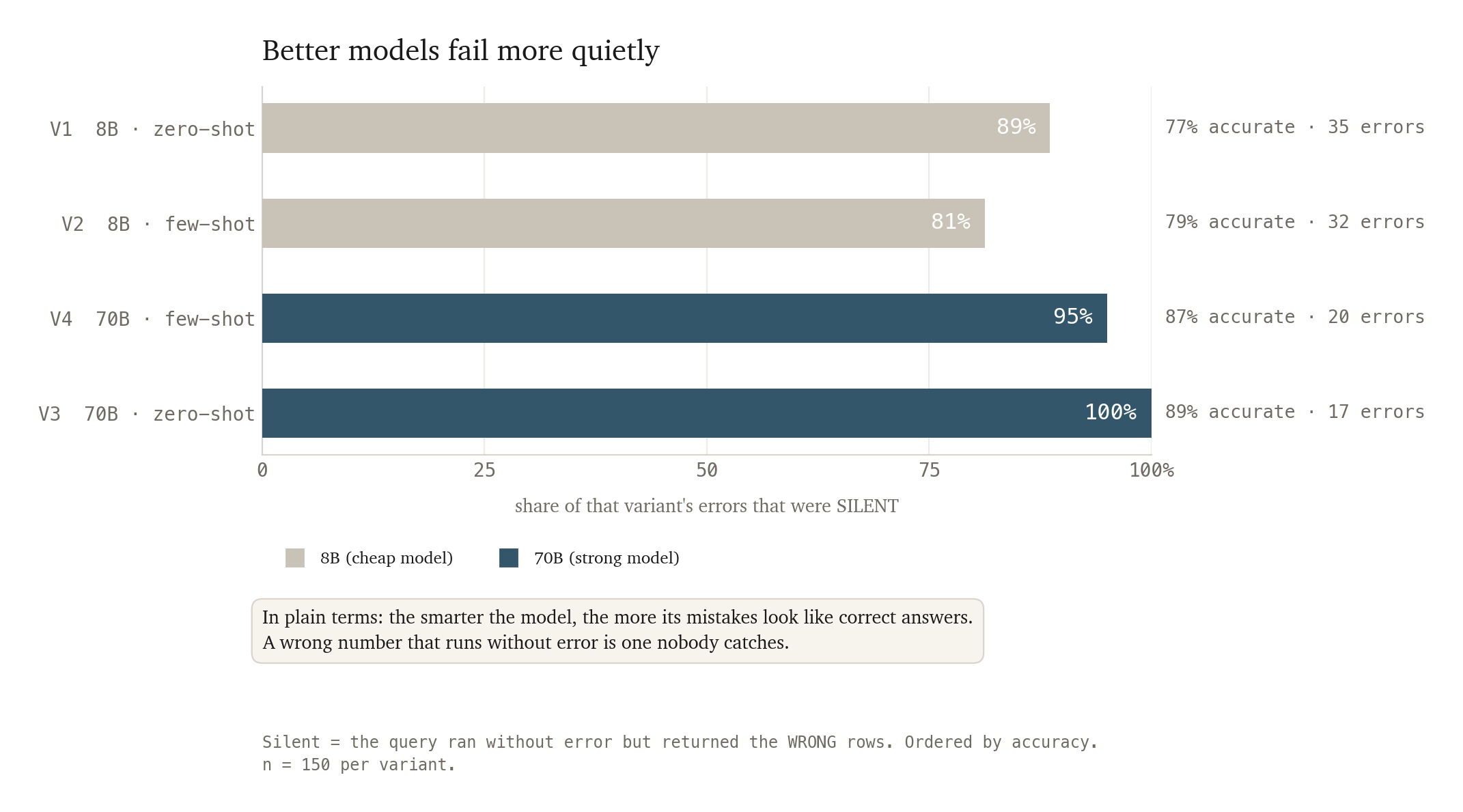 never fails loudly
Broken out by question difficulty rather than by variant, 82% of errors on complex questions were silent, 95% on simple, and 97% on the middle tier. The strongest model also reported 95% average confidence on the answers it got wrong, so nothing in its own output flags the problem.
Exhibit: one real failure
SELECT job_title
FROM jobs
WHERE min_salary > 9000
SELECT JOB_TITLE
FROM jobs
WHERE MAX_SALARY > 9000
04Result: prompting did nothing, model size did
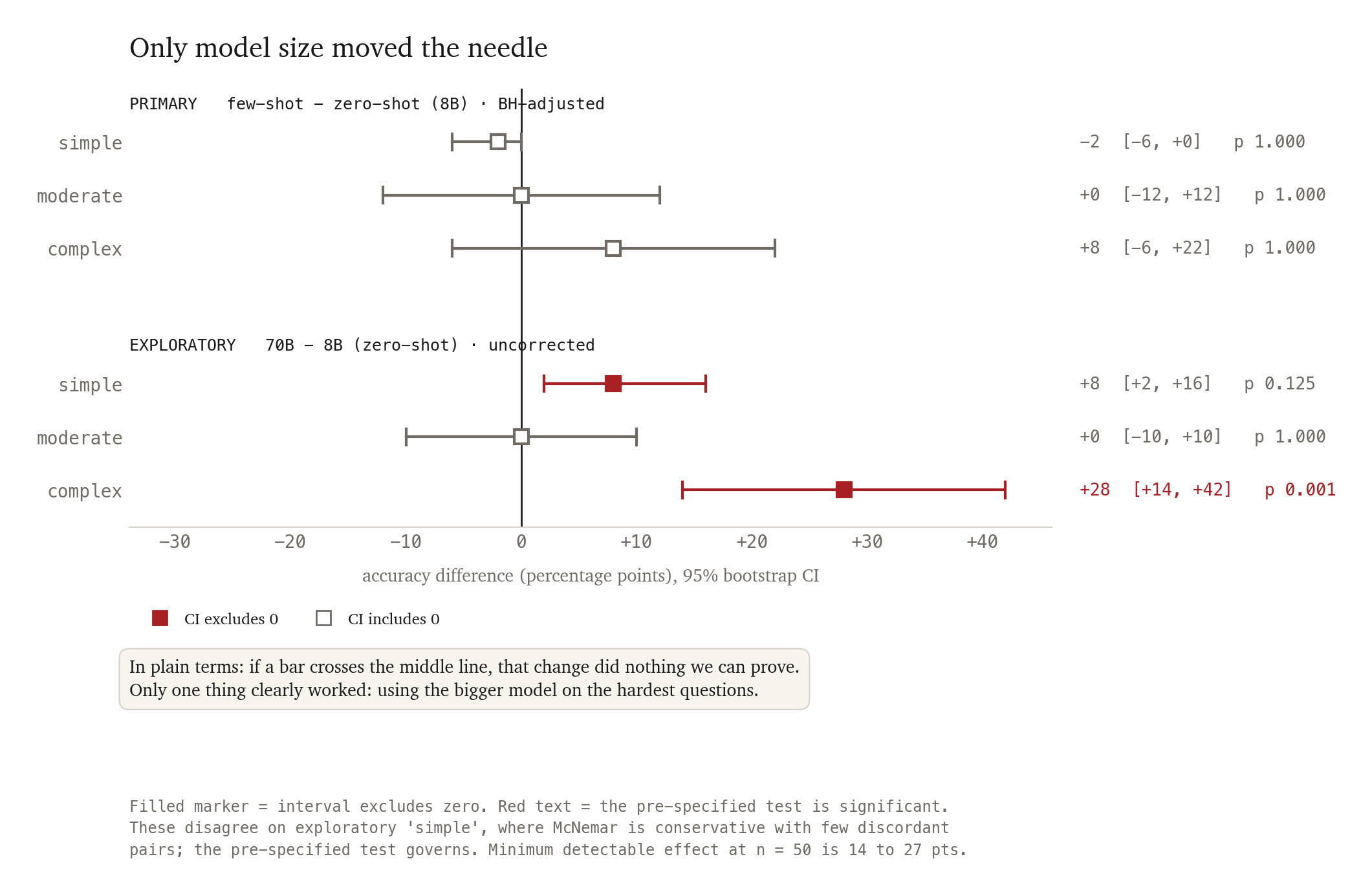 only one clearing zero
Every prompt-effect interval crosses zero. A ten-question pilot had suggested few-shot nearly doubled accuracy on complex queries. At the full sample it collapsed to a non-significant eight points. The pre-registration is the reason this appears as a null result rather than a discovery.
  complex (n=50 paired)
    V1 acc=0.600  V2 acc=0.680  diff=+8.0 pts  95% CI [-6.0, +22.0]
    discordant: V1-only=5  V2-only=9  (both correct=25, both wrong=11)
    McNemar exact p = 0.4240

Benjamini-Hochberg FDR across the primary comparisons (α=0.05):
  simple    raw p=1.0000  adj p=1.0000  not significant
  moderate  raw p=1.0000  adj p=1.0000  not significant
  complex   raw p=0.4240  adj p=1.0000  not significant
| Tier | V1 8B zero | V2 8B few | V3 70B zero | V4 70B few |
|---|---|---|---|---|
| simple | 0.88 [.12] | 0.86 [.14] | 0.96 [.04] | 0.92 [.06] |
| moderate | 0.82 [.18] | 0.82 [.16] | 0.82 [.18] | 0.84 [.16] |
| complex | 0.60 [.32] | 0.68 [.22] | 0.88 [.12] | 0.84 [.16] |
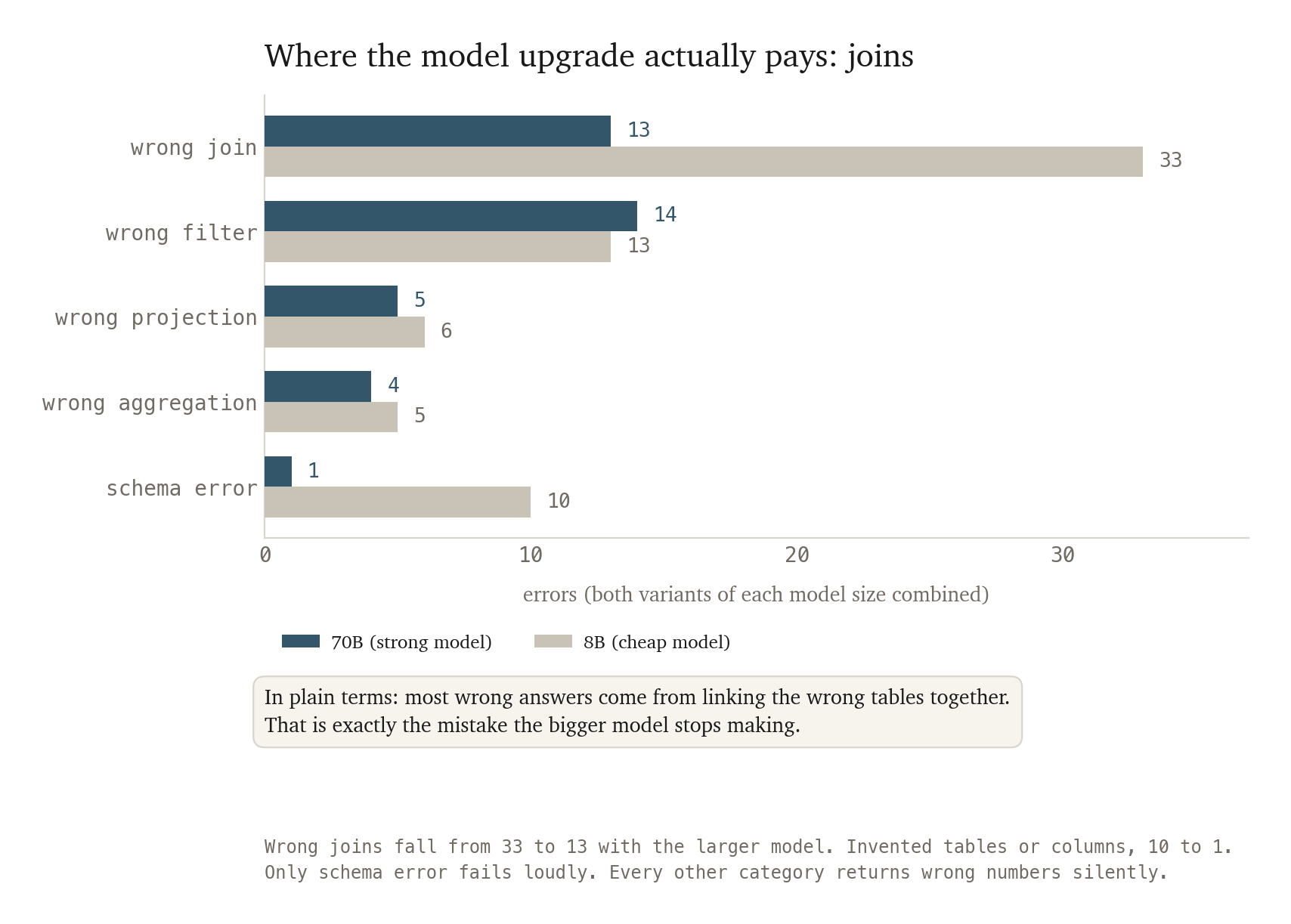
The 8B to 70B upgrade gave +28 points on complex queries (95% CI [+14, +42], p = 0.0013) zero-shot and +16 points (p = 0.039) few-shot. Those are the only significant effects in the study. On the moderate tier the same upgrade gave exactly zero: every variant landed between 0.82 and 0.84, which suggests whatever limits accuracy there is not something this design manipulates.
05Result: confidence is useless, agreement is not
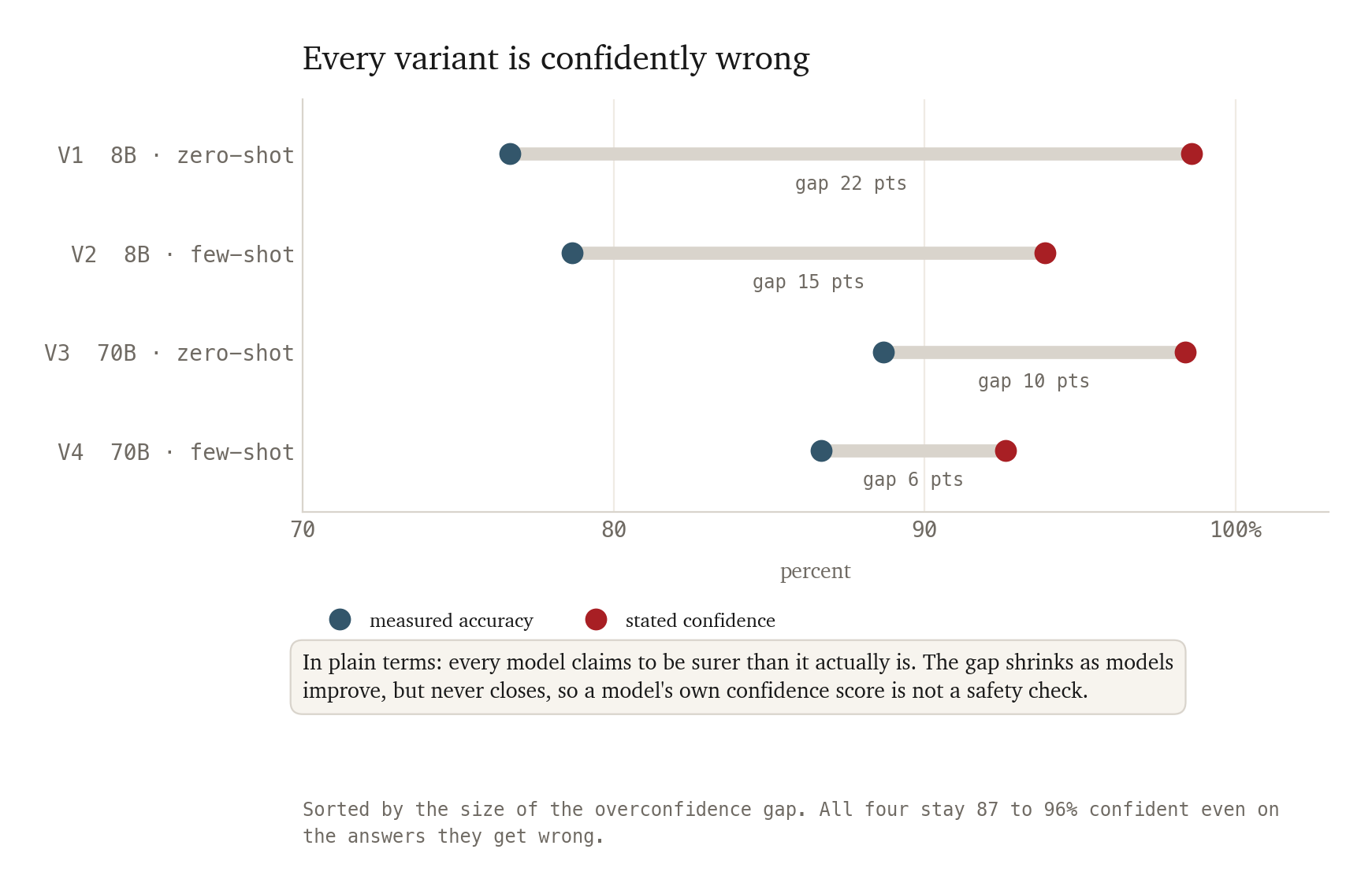
The weakest variant reported 98.6% average confidence while being correct 76.7% of the time. All four stay between 87% and 96% confident on the answers they get wrong, so confidence carries almost no information about whether any specific query is right.
| Signal | AUC | Flags | Errors caught | False alarms |
|---|---|---|---|---|
| Cross-model result agreement | 0.861 | 28% (168/600) | 84% (87/104) | 16% (81/496) |
| Query structure agreement | 0.710 | 74% | 100% | 69% |
| Self-reported confidence | 0.647 | n/a | n/a | n/a |
None of these signals requires the correct answer, so all three are available in production. Reviewing only the 28% of queries (168 of 600) where four model setups (two models, two prompts each) disagree on the executed result catches 84% of all errors (87 of 104), at a 16% false-alarm rate (81 of 496 correct queries flagged). The price is running every question through all four setups.
06Result: difficulty routing did not beat random
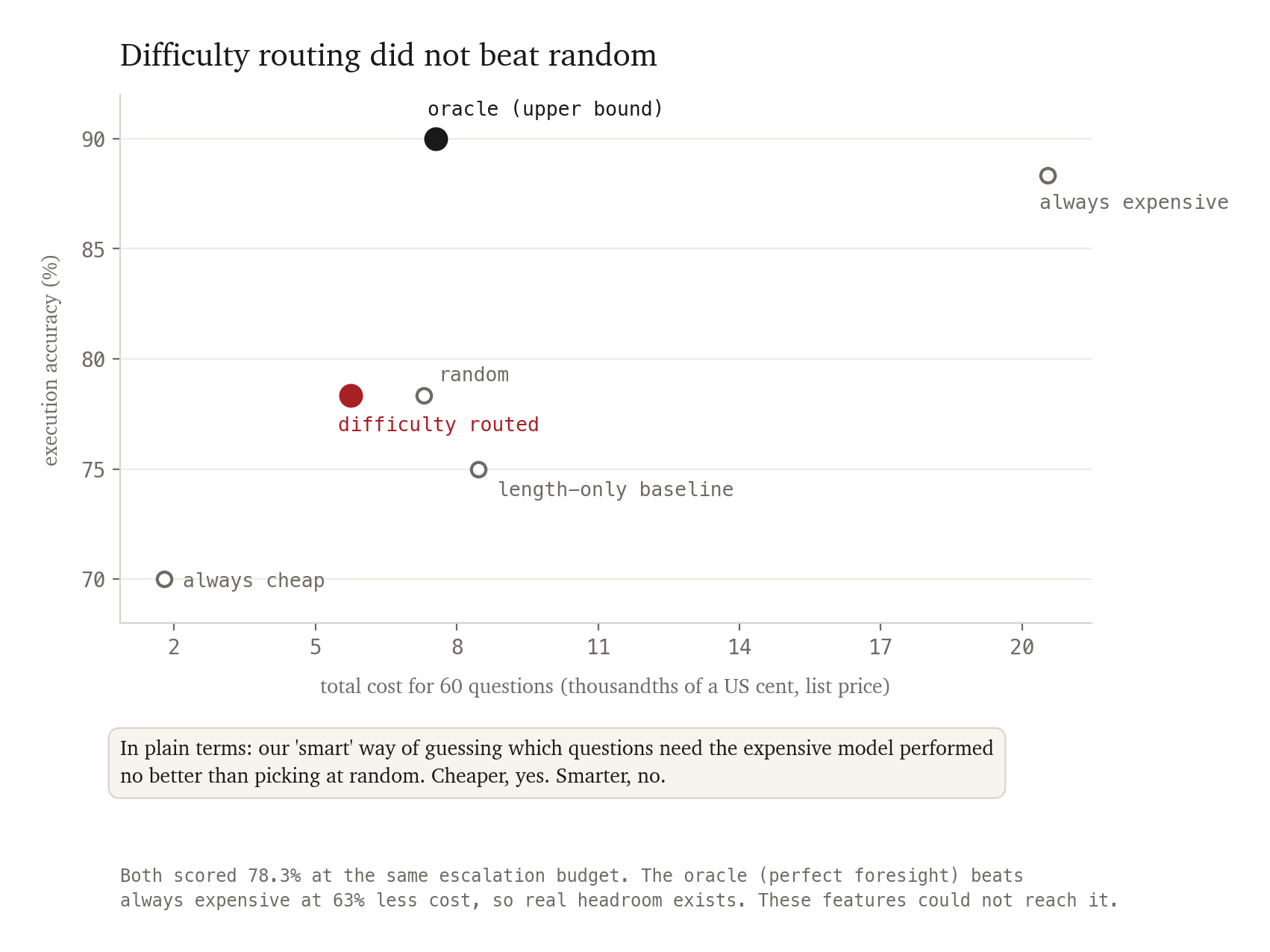
The predictor uses only features computable from the question text and the schema, before any SQL is generated. A single feature, question length, scored AUC 0.724 and beat the six-feature model at 0.665. Schema size was noise at 0.507. Holding out an entire tier dropped complex-tier prediction to chance. Holding out entire databases, which is the production question, held at 0.670 across 93 folds.
Two findings here matter more than the routing number. The oracle reached 0.900 accuracy at 37% of the always-expensive cost, beating always-expensive on both axes, so real headroom exists and these features could not reach it. And cost and difficulty are driven by different things: question length predicts difficulty but not cost, while schema size predicts cost almost perfectly (r = 0.95) and difficulty not at all. Input tokens are 95% of spend because the schema is pasted into every prompt.
07Deployment recommendation
- Spend on the model, not the prompt, and only where it pays. The upgrade bought 28 points on complex queries and nothing on moderate ones.
- Never gate on self-reported confidence. A model claiming 99% certainty was wrong 23% of the time and stayed roughly 95% confident on its own mistakes.
- Gate on cross-model disagreement instead. Run four model setups (two models, two prompts each), compare the executed results, route disagreements to review. 28% reviewed (168 of 600), 84% of errors caught (87 of 104).
- Assume wrong answers will look right. Between 82% and 97% of errors executed cleanly, so guardrails belong on results: row-count sanity, join fan-out checks, reconciliation against known totals.
- Check a length-only baseline before building a difficulty router. Mine lost to it, and both lost to random.
08Validation and constraints
The scorer was cross-validated against the official Spider evaluation script. The one disagreement is a spurious match, two structurally different queries that both happened to return 12, which is the known limitation of single-instance execution accuracy rather than a defect in the comparison logic.
Cross-check of 30 V1 predictions vs official eval_exec_match:

  scored by both : 19
  AGREE          : 18/19  (95%)
  disagree       : 1
  unscorable by official (parser/schema limits): 11
The experiment ran entirely on free-tier infrastructure, which imposed a real constraint. The 70B model carries a hard daily token ceiling, and the run hit it:
Error code: 429 {'error': {'message': 'Rate limit reached for model
`llama-3.3-70b-versatile` in organization `org_01kv...` service tier
`on_demand` on tokens per day (TPD): Limit 100000, Used 99060,
Requested 1048. Please try again in 12m16s.'}}

Generated 165, skipped(cached) 19, failed 16.
Limitations
- Benchmark contamination
- Spider is public and predates these models' training cutoffs, so absolute accuracies are probably optimistic. All four variants are affected equally, which makes the comparisons more trustworthy than the raw numbers.
- Underpowered for small effects
- Minimum detectable effect at 50 questions per tier is roughly 14 to 27 points. A real but moderate few-shot benefit would not have been detected.
- Complexity is tangled with length and schema size
- Harder tiers came from larger databases and longer questions, so the complexity effect cannot be fully separated from a context-length effect.
- The moderate tier is uninformative
- All four variants landed between 0.82 and 0.84, so neither factor in this design moves it.
- One model family, list-price costs
- Both models are Llama variants from one provider, so the model effect means size within a family rather than a comparison between vendors.